Teachers employ multiple AI detection strategies to identify AI-generated content in student submissions. Educators increasingly face challenges in distinguishing authentic student work from AI-assisted assignments, making it important to maintain academic integrity while avoiding false accusations. AI detection methods include using specialized tools, analyzing linguistic patterns, identifying AI signatures, and verifying student understanding through verbal discussions. Understanding these strategies helps students recognize the importance of authentic learning beyond technological shortcuts.
CudekAI AI Detector provides educators with reliable AI content identification through advanced machine learning, analyzing text patterns, perplexity, burstiness, and 15-dimensional linguistic characteristics, delivering accurate detection within seconds. The system helps teachers verify student work authenticity, maintaining educational standards while supporting fair assessment. Try CudekAI AI Detector with trial access and experience superior AI detection technology.
Why Do Teachers Need to Check for AI?
Educators verify AI usage, protecting academic integrity, ensuring authentic learning assessment, maintaining fair evaluation standards, and developing students’ critical thinking skills.
Protecting Academic Integrity
Academic institutions establish integrity standards, requiring students to demonstrate original thinking, genuine comprehension, and authentic skill development. AI-generated submissions undermine these foundations, presenting machine-created content as personal intellectual achievement, constituting academic dishonesty similar to traditional plagiarism.
Teachers maintain integrity expectations, ensuring degrees and qualifications represent genuine student capabilities rather than AI tool access. Unchecked AI usage devalues educational credentials, threatening institutional reputations and graduate employability when employers discover degree holders lack advertised competencies.
Ensuring Authentic Learning Assessment
Assignments assess student understanding, skill development, and knowledge application, enabling teachers to evaluate learning progress and identify areas requiring additional instruction. AI-generated work prevents accurate assessment, hiding comprehension gaps behind sophisticated machine-generated text.
Teachers need authentic student work to determine whether learners grasp concepts, apply knowledge appropriately, and develop critical thinking skills essential for future success. AI shortcuts prevent identifying struggling students requiring intervention while rewarding technology access over genuine learning.
Maintaining Fair Evaluation Standards
Students producing original work deserve fair evaluation when competing against peers submitting similar authentic efforts. AI usage creates unfair advantages where some students receive unearned credit through technological assistance while others invest genuine effort in developing skills.
Educational equity requires consistent standards preventing advantage through prohibited resources. Teachers checking for AI maintain level playing fields, ensuring grades reflect actual student capabilities rather than AI tool sophistication or access disparities.
What Are Common Manual Detection Methods?
Experienced educators employ proven manual techniques, identifying AI-generated content through careful analysis and professional judgment.

Comparing Against Previous Student Work
Teachers familiar with individual student writing styles recognize deviations indicating potential AI usage. Sudden improvements in vocabulary sophistication, sentence complexity, writing fluency, or organizational quality without corresponding skill development raise immediate suspicion.
Comparing submissions against previous essays, in-class writing samples, or earlier assignments reveals inconsistencies. Students demonstrating consistent basic writing patterns, suddenly producing polished, sophisticated prose, likely received external assistance. Handwritten work samples provide baseline comparisons unaffected by AI tools.
Voice and tone consistency matter where students typically maintain recognizable writing personalities across assignments. AI-generated content often exhibits a different voice, lacking personal expression, individual quirks, or characteristic stylistic preferences.
Identifying Characteristic AI Signatures
AI-generated text exhibits distinctive patterns experienced teachers recognize, including an overly formal academic tone inappropriate for the assignment level; generic, broad statements lacking specific examples or personal insight; mechanical transitions using predictable phrases; perfect grammar without typical student errors; and unnaturally smooth prose lacking an authentic voice.
Language models favor certain vocabulary and phrasing, creating repetitive patterns. Terms like “delve,” “landscape,” “navigate,” “robust,” “tapestry,” and “multifaceted” appear with statistically improbable frequency in AI writing compared to authentic student prose. Teachers wanting a deeper breakdown of telltale signs should review our practical guide on how to tell if something was written by ChatGPT, covering specific patterns, vocabulary tells, and structural markers identifying ChatGPT-generated content.
Structural uniformity, where every paragraph maintains identical length, sentences follow predictable patterns, and organization demonstrates mechanical perfection, suggests AI generation over authentic student composition.
Examining Content Quality and Depth
AI-generated submissions often demonstrate surface-level understanding, presenting broad generalizations without deep analysis, specific examples, or original insight. Generic statements applicable to any similar topic indicate machine generation rather than genuine engagement with assignment specifics.
Teachers evaluate whether content demonstrates actual comprehension, showing nuanced understanding, critical analysis, specific evidence application, and original thinking connecting concepts in unique ways. Superficial coverage despite sophisticated language suggests AI assistance.
Factual errors and hallucinations provide clear AI indicators where systems confidently state incorrect information, fabricate quotes, misattribute sources, or invent statistics. While students make mistakes, AI hallucinations often involve confident assertion of obviously false claims easily verified as fabrications.
Testing Student Knowledge Verbally
Oral examinations and discussions reveal whether students understand the submitted work content. Teachers asking students to explain main arguments, defend thesis positions, discuss evidence choices, or elaborate on specific passages quickly identify whether genuine comprehension exists.
Students producing AI-generated work struggle explaining reasoning, cannot elaborate beyond submitted text, provide vague responses to specific questions, or demonstrate unfamiliarity with their own “writing.” Authentic authors naturally discuss work details, thought processes, and decision-making behind specific choices.
Follow-up assignments requiring similar work under supervised conditions confirm capabilities. Students submitting sophisticated AI-generated essays producing significantly lower-quality supervised work reveal the inauthenticity of their previous submissions.
What AI Detection Tools Do Teachers Use?
Educators increasingly employ specialized software designed to identify AI-generated content through sophisticated algorithmic analysis.
How AI Detectors Analyze Text
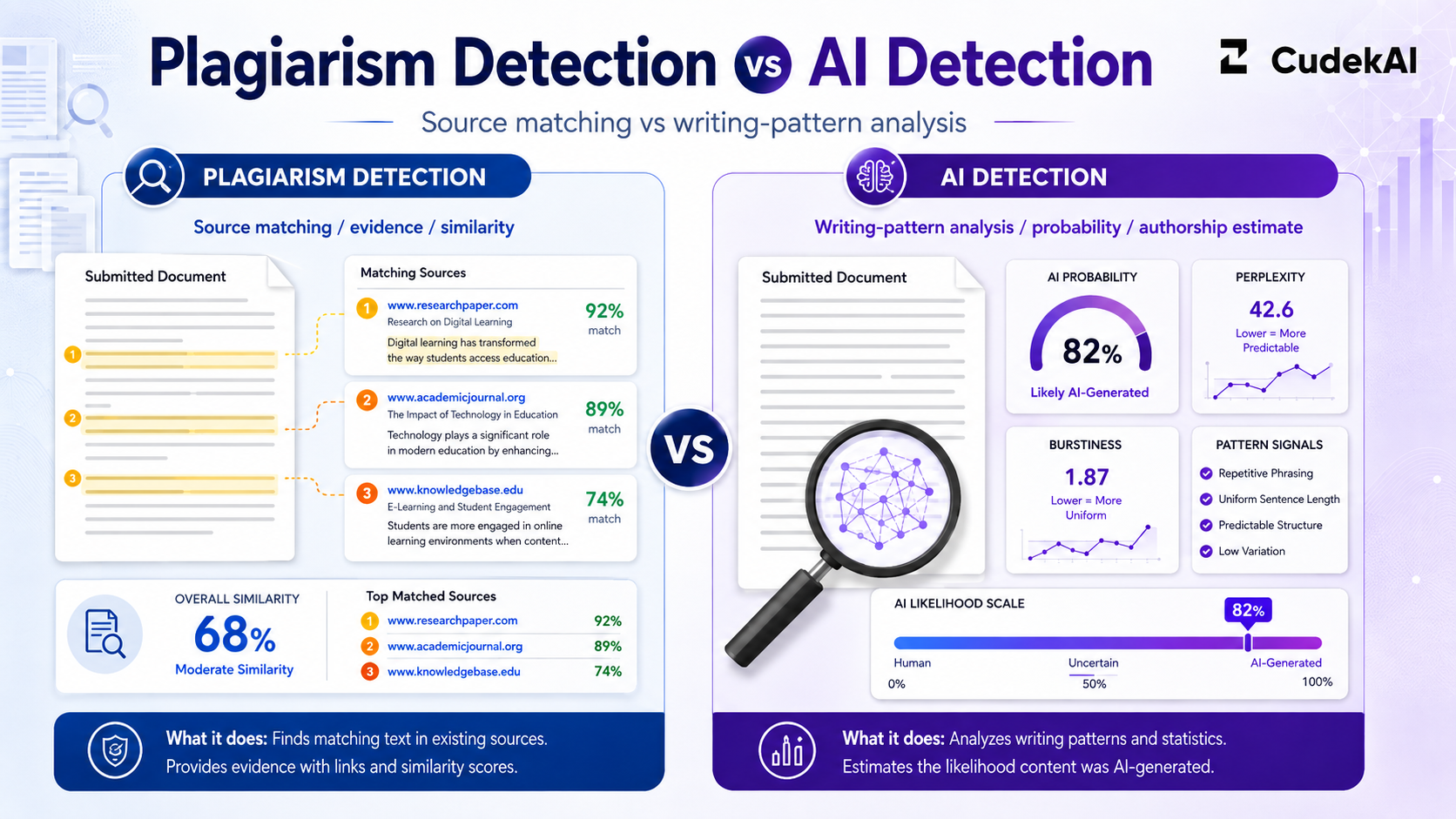
AI detection tools employ machine learning models trained on millions of human-written and AI-generated text samples, learning to distinguish linguistic patterns. These systems analyze multiple dimensions, including perplexity, measuring text predictability; burstiness, evaluating sentence length variation; vocabulary distribution, examining word choice patterns; and structural characteristics, identifying mechanical construction. For a foundational overview of how these systems work, our complete guide on how AI detectors work explains the technology, methodologies, and practical applications across educational settings.
Advanced detectors like CudekAI employ 15-dimensional analysis, examining comprehensive linguistic features beyond basic pattern matching. Multi-dimensional evaluation increases accuracy, reducing false positives while catching sophisticated AI generation attempts.
Detection algorithms compare submitted text against known AI writing characteristics, identifying statistical anomalies, pattern matches, and signature indicators suggesting machine generation. Probabilistic scoring indicates likelihood percentages rather than definitive determinations requiring teacher interpretation.
For a detailed technical explanation of detection mechanisms helping to understand what teachers evaluate when checking AI usage, see our comprehensive guide on How Accurate is ChatGPT Detector, covering detection technology, accuracy rates, and limitation awareness.
Popular Teacher Detection Platforms
Educational institutions deploy various AI detection solutions integrated with learning management systems. Turnitin offers institutional-grade detection scanning of student submissions automatically through existing assignment workflows. GPTZero provides accessible detection targeting educational contexts with classroom-friendly interfaces.
Copyleaks combines plagiarism and AI detection, scanning content simultaneously against copied material and AI generation. OriginalityAI specializes in content authenticity verification across academic and professional contexts.
CudekAI AI Detector delivers superior detection through advanced algorithms, providing detailed analysis, confidence scoring, and actionable insights. The system processes submissions within seconds, delivering comprehensive reports helping teachers make informed academic integrity decisions.
Understanding Detection Accuracy and Limitations
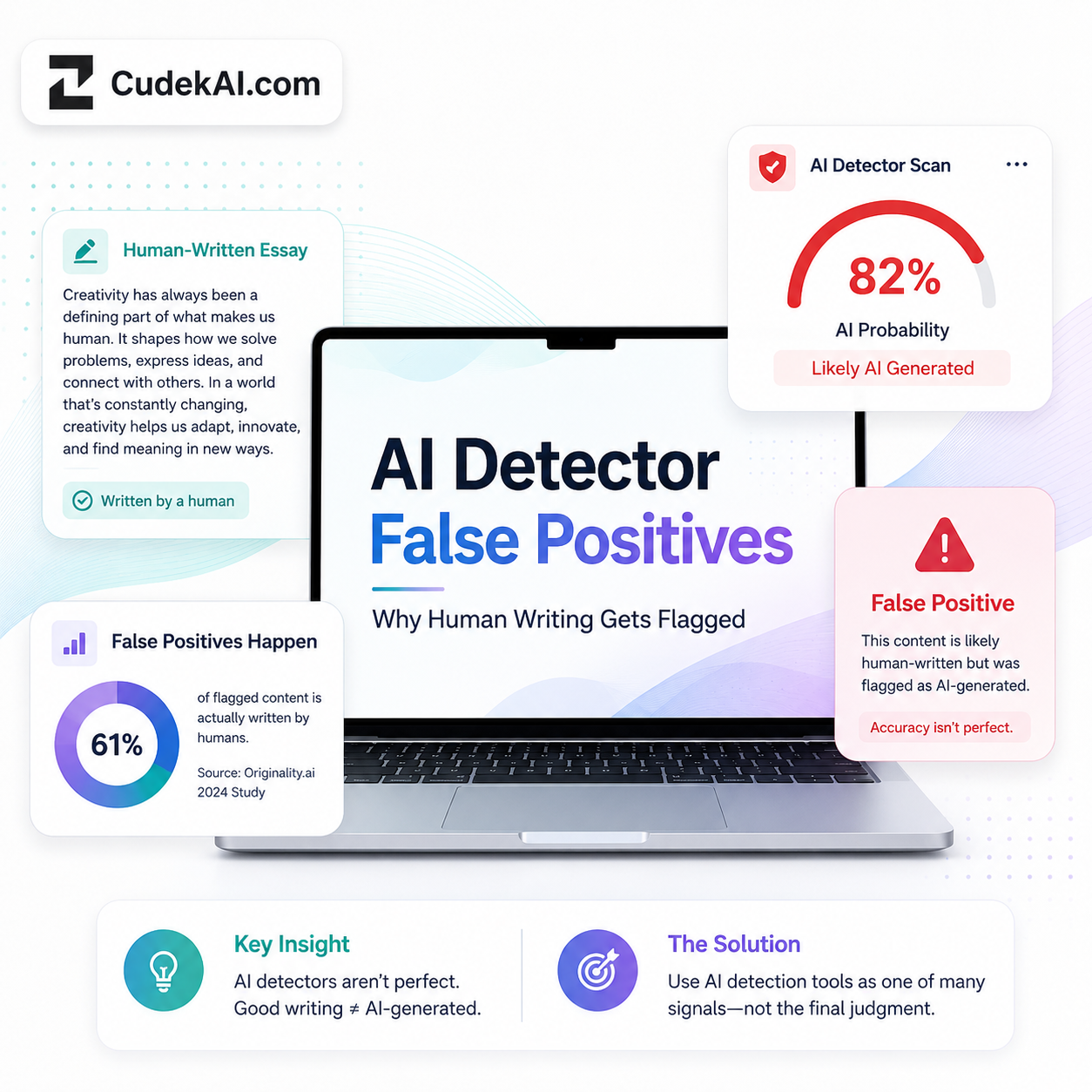
No AI detector achieves 100% accuracy, creating risks of false positives flagging authentic student work or false negatives missing AI-generated content. Detection accuracy varies based on AI model sophistication, text length, content subject matter, and detection algorithm quality.
Teachers must interpret detection results as probability indicators rather than definitive proof. High AI likelihood scores warrant investigation through additional verification methods, while low scores don’t guarantee authenticity, requiring professional judgment balancing automated detection with manual review.
Humanized AI content specifically designed to evade detection may bypass standard checkers. Students employing AI humanization tools or extensive manual editing reduce detection likelihood, creating an ongoing technological arms race between generation and detection capabilities.
How do teachers verify AI Detection Results?
Responsible educators confirm automated detection findings through multiple verification approaches, preventing false accusations while addressing genuine violations.
Requesting Work Process Documentation
Teachers asking students to provide draft progression, research notes, outline development, and revision history verify authentic writing processes. AI-generated work typically lacks iterative development, showing completely polished submissions without typical draft evolution.
Students producing genuine work easily provide supporting materials demonstrating research, planning, drafting, and revision stages. Inability to provide process documentation despite sophisticated final products suggests AI assistance.
Conducting Student Conferences
Personal discussions about submitted work reveal comprehension depth and authorship authenticity. Teachers asking open-ended questions about thesis development, evidence selection, argument construction, and specific writing choices assess whether students demonstrate ownership and understanding.
Authentic authors articulate reasoning, explain revisions, discuss challenges encountered, and elaborate on ideas naturally. Students submitting AI work often provide vague responses, cannot explain specific choices, or demonstrate a superficial understanding inconsistent with sophisticated writing quality.
Comparing Multiple Assessment Methods
Triangulating evidence across various assessment types reveals capability patterns. Students producing AI-generated essays but struggling with in-class writing, exam responses, or supervised assignments demonstrate inconsistent performance, indicating external assistance.
Teachers noting dramatic quality differences between supervised and unsupervised work investigate further. Consistent performance across assessment contexts suggests authentic capability, while significant variations warrant integrity concerns.
How do teachers prevent AI Usage in Assignments?
Forward-thinking educators design assignments and assessment structures, reducing AI usage temptation while promoting authentic learning.

Assignment Design: Preventing AI Completion
Teachers craft assignments requiring specific personal experiences, local examples, class discussion references, or particular source materials that AI systems cannot replicate. Requiring citation of specific assigned readings, incorporation of in-class activities, or application to personal contexts prevents generic AI generation.
Unique prompts changed each semester prevent students from finding or generating standard responses. Assignments requiring multimedia components, specific formatting, or particular structural requirements beyond simple essay writing reduce AI applicability.
Emphasizing Process Over Product
Requiring draft submissions, peer review participation, research log maintenance, and revision tracking ensures students engage with writing processes rather than submitting complete AI-generated products. Process-focused assessment values development over final perfection, reducing AI shortcut appeal.
Scaffolded assignments, breaking large projects into smaller incremental submissions, prevent AI bulk generation while supporting authentic skill development through guided progression.
Promoting AI Literacy and Ethical Usage
Progressive educators teach appropriate AI tool usage, including research assistance, brainstorming support, and editing help, while emphasizing that final work must represent student thinking, writing, and understanding. Clear usage guidelines distinguish acceptable assistance from prohibited AI writing.
Discussing AI detection methods, academic integrity consequences, and learning value transparency encourages ethical decision-making. Students’ understanding of detection sophistication and violation consequences makes them make more informed choices.
How Accurate is ChatGPT Detector Technology?
AI detector accuracy varies significantly across platforms, content types, and AI generation methods, requiring teachers to understand reliability limitations.
Detection Accuracy Rates
Leading detectors claim 95-99% accuracy rates, though independent testing reveals lower real-world performance, particularly with humanized content, shorter texts, or sophisticated prompting. Detection reliability depends on training data quality, algorithm sophistication, and AI model coverage.
False positive rates prove particularly concerning when authentic student work receives incorrect AI flags. Studies show that ESL students, neurodivergent writers, and students using formal academic language face higher false positive risks, creating equity concerns.
CudekAI AI Detector employs a comprehensive 15-dimensional analysis, reducing false positive risks while maintaining high true positive detection rates. Advanced algorithms trained on diverse writing samples recognize authentic human variation, distinguishing genuine student work from AI generation.
Factors Affecting Detection Reliability
Text length impacts accuracy, where longer submissions provide more pattern evidence, enabling reliable detection, while brief responses lack sufficient indicators. Subject matter affects detection, where technical writing, formulaic content, or standardized formats reduce distinctive pattern recognition.
AI model sophistication influences detection difficulty. Advanced models producing more human-like text challenge detectors, while basic generation proves easier to identify. Humanization tools specifically designed to evade detection significantly reduce accuracy.
Detection algorithm training determines capability. Systems trained on diverse AI models, updated regularly, and incorporating the latest generation techniques maintain better accuracy than static, outdated tools.
What Should Students Know About AI Detection?
Students’ understanding of teacher detection capabilities enables them to make informed decisions, balancing AI tool usage with academic integrity and authentic learning.
Detection is Increasingly Sophisticated
Educational institutions invest heavily in AI detection technology, making the submission of undetected AI-generated work increasingly difficult. Teachers combine automated tools with professional judgment, creating a multi-layered detection approach with high reliability.
Students assuming AI usage remains undetectable underestimate both technological capabilities and teacher expertise in identifying characteristic patterns through experience. The risk-reward calculation heavily favors authentic work over detection avoidance attempts.
Academic Consequences Can Be Severe
AI-generated submission violations typically result in serious penalties, including assignment failure, course failure, academic probation, transcript notation, or program expulsion, depending on institutional policies and violation severity.
Beyond immediate academic consequences, integrity violations create lasting impacts affecting graduate school applications, professional licensing, employment background checks, and personal reputation. Short-term AI shortcuts risk long-term consequences outweighing temporary convenience.
Authentic Learning Provides Real Value
Education develops critical thinking, communication skills, problem-solving abilities, and knowledge application valuable beyond grades or degrees. AI shortcuts prevent skill development, leaving students unprepared for professional demands requiring capabilities degrees supposedly represent.
Employers, graduate programs, and professional contexts expect that competencies should develop. Students relying on AI during education face exposure when real-world demands reveal capability gaps that AI concealed during assessment.
Final Thoughts
Teachers employ comprehensive AI detection strategies combining automated tools that analyze linguistic patterns and statistical anomalies, manual comparison against known student writing to identify AI signatures, student knowledge verification through verbal discussions and process documentation, and preventive assignment design that reduces AI usage while promoting authentic learning. AI detection technology continues to evolve, with platforms like CudekAI AI Detector offering advanced multi-dimensional analysis and delivering results within seconds. However, no system is fully accurate, so teachers must balance automated tools with professional judgment, multiple verification methods, and fair review processes to prevent false accusations while addressing genuine cases.
Students should recognize the growing sophistication of AI detection, making undetected AI usage increasingly difficult, while understanding that academic consequences and authentic learning outcomes outweigh short-term shortcuts. Academic integrity remains central to education, focusing on developing real skills, critical thinking, and knowledge application for future success.
Educators seeking reliable AI detection tools require systems that provide accurate analysis with low false positive rates. CudekAI AI Detector offers 15-dimensional analysis, strong pattern recognition, and detailed reporting to help verify student work authenticity. Start the CudekAI AI Detector trial, experiencing professional-grade detection technology supporting educational standards and authentic learning verification.