Support Global Languages
Check content similarity across 100+ languages, including Spanish, Russian, Portuguese, Arabic, Indonesian, Italian, Dutch, Korean, Japanese, Vietnamese, French, Swedish, Romanian, Norwegian, Danish, Turkish, and more.
🎉 Get 7 months FREE on any annual plan — no risk, cancel anytime
06
HR
00
MIN
00
SEC
Check duplicate and rephrased content with the CudekAI free plagiarism checker. Upload files, paste text, or scan URLs to identify sources and get instant citation suggestions.
Supported Languages:
English
French
Spanish
German
All others
(.doc, .docx, .pdf)
🗑
0/1000
2 credits cost
Plagiarism checking could take approximately 1-3 minutes depending on the text
Settings
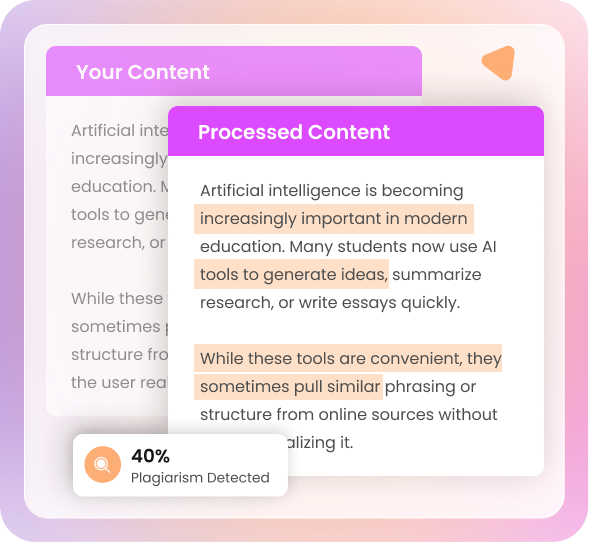
The plagiarism checker scans documents and web pages to detect duplicated text. CudekAI highlights similar sentences and paragraphs while calculating a clear plagiarism percentage. The advanced analysis also identifies original sources for accurate originality verification.
Detect paraphrased content by analyzing sentence structures, paragraph patterns, and full-document context. CudekAI's free plagiarism checker highlights rewording and paraphrasing plagiarism, ensuring precise similarity scores for reliable verification.
Identifies sources across all inputs and provides source recommendations for proper citation. The plagiarism checker generates APA, MLA, and Chicago-style references; highlights quotations; corrects attribution with quotation marks; and suggests verified cited results.
Check content similarity across 100+ languages, including Spanish, Russian, Portuguese, Arabic, Indonesian, Italian, Dutch, Korean, Japanese, Vietnamese, French, Swedish, Romanian, Norwegian, Danish, Turkish, and more.
Achieve high-accuracy detection with CudekAI free plagiarism checker, powered by advanced AI and machine learning. It identifies patchwriting, partial, and exact matches through deep scanning while maintaining content authenticity.
Access a continuously updated global database of millions of sources, including online content, offline documents, academic papers, journals, ebooks, blogs, and video transcripts. The plagiarism checker ensures reliable and up-to-date content verification.
Examine sentence structure, syntax, and stylistic patterns for accurate similarity detection. CudekAI Plagiarism Checker applies pattern-based similarity, linguistic fingerprinting, and style mapping to highlight structure and patterns across documents.
Review documents side-by-side for easy checking. Plagiarism checker enables manual review, highlights original content alongside text, and traces similarities across documents for precise verification.
01
Paste a URL, copy-paste text, or upload files to scan webpages and documents with optional URL exclusions. Supported formats include DOCX, PDF, TXT, RTF, HTML, PPT, and more.
02
Run a real-time plagiarism check with advanced text analysis and source comparison to detect copied content with CudekAI's free plagiarism checker.
03
The plagiarism checker generates a percentage-based report with highlighted matches and a source list for verification. Download the detailed report in your preferred format.
Discover how the CudekAI plagiarism checker ensures content originality across academia, businesses, and creative projects.
Students, teachers, and researchers can maintain academic integrity across assignments. CudekAI plagiarism detector detects essay, thesis, and research paper plagiarism with precise analysis. It verifies quotations, applies proper attribution, and supports accurate citation practices.
Business professionals can detect plagiarism in projects, resumes, books, corporate reports, presentations, and emails. The AI plagiarism checker ensures professional standards across large-scale content.
Bloggers, editors, and publishers verify blog posts, articles, and web content for originality. The CudekAI plagiarism checker also supports creative writers in verifying poems and other creative works while maintaining writing integrity.
Best for agencies
Custom Pricing
Credits: Tailored for You
AI Detector
Humanizer
Plagiarism Checker
AI Image Detector
All Apps Included
Translator
Performs content scanning with API integration. CudekAI enables teams to automate plagiarism detection for multiple documents with full API access.
Instant
Bulk Analysis
Ready to automate?
Get API access today.
CudekAI’s plagiarism checker scans content across multiple languages to detect duplicate text, matched sources, and originality issues with high accuracy. Check essays, blogs, academic papers, and SEO content without translating your text.
English
Afrikaans
Albanian
Amharic
Arabic
Armenian
Azerbaijani
Basque
Belarusian
Bengali
Bosnian
Bulgarian
Catalan
Cebuano
Chichewa
Chinese Simplified
Chinese Traditional
Corsican
Croatian
Czech
Danish
Dutch
Esperanto
Estonian
Filipino
Finnish
French
Frisian
Galician
Georgian
German
Greek
Gujarati
Haitian Creole
Hausa
Hawaiian
Hebrew
Hindi
Hmong
Hungarian
Icelandic
Igbo
Indonesian
Irish
Italian
Japanese
Javanese
Kannada
Kazakh
Khmer
Korean
Kurdish
Kyrgyz
Lao
Latin
Latvian
Lithuanian
Luxembourgish
Macedonian
Malagasy
Malay
Malayalam
Maltese
Maori
Marathi
Mongolian
Myanmar
Nepali
Norwegian
Pashto
Persian
Polish
Portuguese
Romanian
Russian
Samoan
Scots Gaelic
Serbian
Sesotho
Shona
Sindhi
Sinhala
Slovak
Slovenian
Somali
Spanish
Sundanese
Swahili
Swedish
Tajik
Tamil
Telugu
Thai
Turkish
Ukrainian
Urdu
Uzbek
Vietnamese
Welsh
Xhosa
Yiddish
Yoruba
Zulu
Cudekai's AI detector has been a real stress reliever. Some of my professors are strict about AI-written work, and this tool gives me confidence that my papers look authentic before I turn them in.
Daniel

I use Cudekai's humanizer tool after finishing my papers to make sure they actually sound like me. It smooths out the writing and makes everything flow naturally—like my own voice, just better polished.
Chelsea
Whenever I'm stuck trying to rephrase something, I just drop it into Cudekai's rewriter. It gives me cleaner, clearer versions in seconds and saves me so much time for other work.
Ricardo
Cudekai's plagiarism checker is really solid. The reports are detailed but easy to understand, which makes fixing issues much quicker. It's a must-have for my projects.
Michael
Explore advanced AI tools designed to enhance content verification and writing workflow.
Identify AI-generated text across sentences, paragraphs, and full documents. CudekAI provides multilingual analysis, human vs. AI classification, and confidence scoring for AI-generated text verification.
Check Cudekai AI DetectorTransforms AI-generated text into natural, human-like writing. The AI humanizer refines phrasing, improves readability, and enhances overall text clarity while keeping the original meaning.
Check Cudekai Humanize AIRephrase sentences and paragraphs, ensuring grammar-safe paraphrasing for academic and professional use. It maintains clarity and consistency across all content.
Check Cudekai Free Paraphrasing ToolCreate accurately formatted references for any document. CudekAI supports in-text citations, reference lists, and bibliographies in APA, MLA, Chicago, Harvard, and other discipline-specific styles. It ensures citation consistency and style compliance.
Check Cudekai Citation GeneratorRun a free plagiarism scan. Generate a plagiarism report in seconds.