AI detectors analyze writing patterns, including word choices, sentence structures, predictability metrics, and stylistic markers, distinguishing human-authored content from AI-generated text. Students, educators, content creators, publishers, and businesses require an understanding of AI detection technology, including how these systems identify machine-written content, which linguistic patterns trigger classification, and which detection methods prove most reliable for different applications.
CudekAI AI Detector employs advanced machine learning algorithms to analyze 15 distinct linguistic dimensions, including perplexity measurement, burstiness analysis, vocabulary distribution, transition phrase frequency, and semantic patterns, delivering accurate AI content identification. The detection system provides sentence-level classification, transparent confidence scoring, and detailed pattern explanations, enabling informed interpretation of results. Try CudekAI AI Detector with trial access to evaluate detection capabilities.
What Are AI Detectors and Why Do They Matter?
AI detectors represent specialized software systems designed to identify content generated by artificial intelligence tools, including ChatGPT, GPT-4, Claude, Gemini, and other language models, versus authentic human writing.
Purpose and Applications
AI detection technology serves critical functions across education, publishing, and content marketing teams to verify writer deliverables, ensuring human creativity and brand voice authenticity. To understand the broader implications, read about the impact of AI detectors on digital marketing and how detection tools are reshaping content strategy, SEO, and brand trust. Educational institutions employ AI detectors to verify student assignment originality, ensuring academic work reflects genuine learning rather than AI-assisted shortcuts undermining educational objectives.
Publishers and media organizations utilize detection systems to identify AI-generated articles, reviews, or news content, maintaining editorial standards and reader trust. Beyond text, visual content authenticity has become equally critical — our AI image detector guide explains how publishers verify image sources in seconds to maintain full content integrity.
Rising Importance
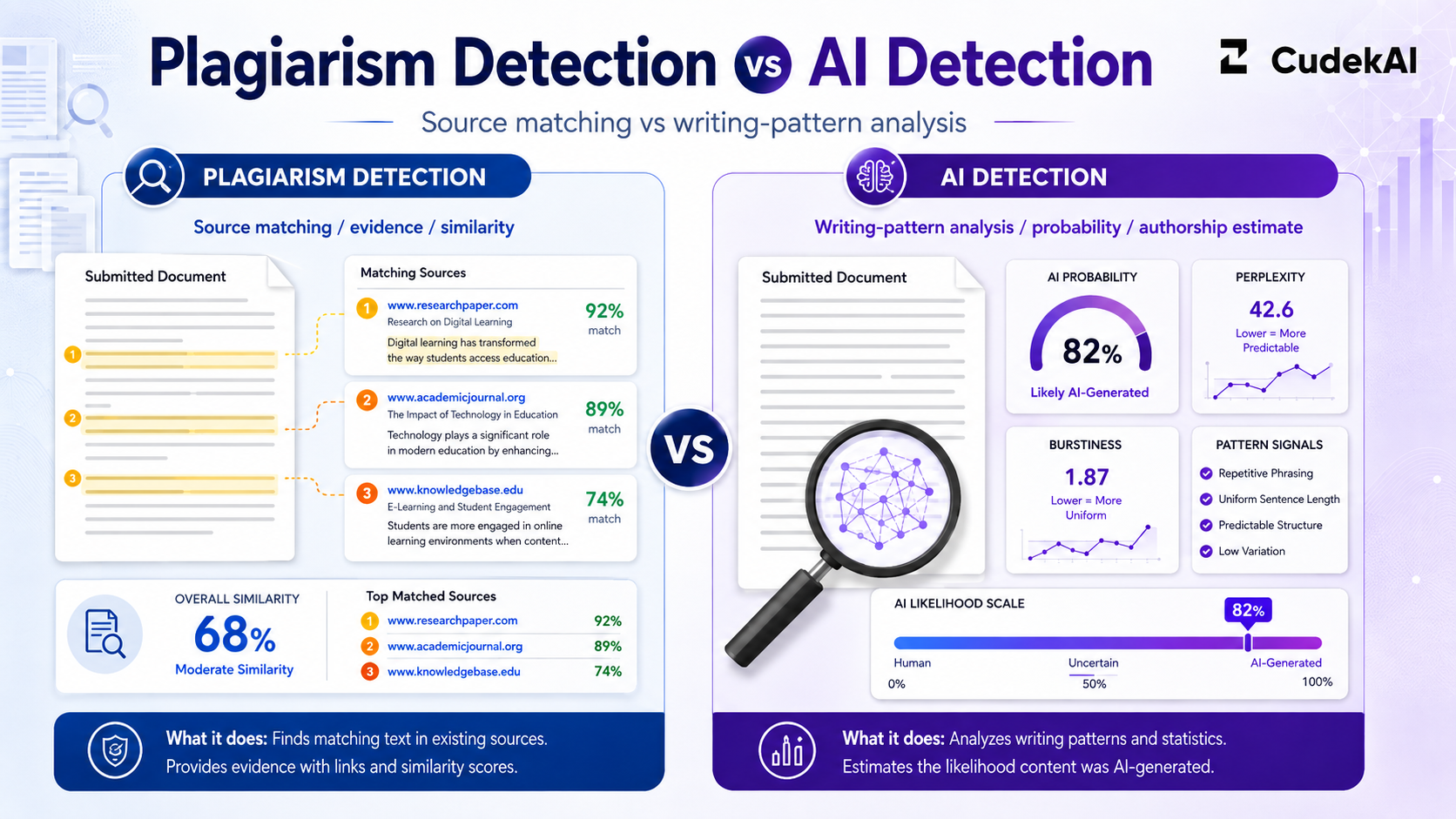
AI writing tool proliferation, including ChatGPT reaching 100 million users within months, creates unprecedented challenges in distinguishing authentic human expression from machine generation. Traditional plagiarism detection proves insufficient as AI generates original text rather than copying existing sources, requiring new detection methodologies analyzing writing characteristics beyond simple matching.
Understanding AI detector functionality enables appropriate interpretation of detection scores, recognition of system limitations, and informed decisions balancing detection results with contextual evidence. Blind trust in detection verdicts without understanding the underlying mechanics risks false accusations or missed AI usage through sophisticated evasion techniques.
How Do AI Detectors Identify Machine-Generated Text?
AI detectors employ multiple analytical approaches, examining different text characteristics, revealing machine-generated patterns invisible through casual reading.

Machine Learning Classification
Classification represents a core AI detection methodology where machine learning models categorize input text into predetermined classes. “AI-written” versus “human-written.” These classifiers undergo extensive training on massive datasets containing millions of labeled examples from both human authors and various AI models learning distinguishing characteristics.
Training data diversity critically impacts detection accuracy, where models exposed exclusively to ChatGPT 3.5 outputs fail to detect GPT-4, Claude, or Gemini content exhibiting different linguistic patterns. Comprehensive training incorporating outputs from ChatGPT versions, Claude variants, Gemini models, LLaMA, Mistral, and other language models enables broader platform detection.
Classifiers analyze multiple features simultaneously, including word usage frequency, sentence length patterns, grammatical complexity, vocabulary diversity, and structural consistency. For practical guidance on spotting these patterns manually, see our guide on how to tell if something was written by ChatGPT, which breaks down the telltale signs even without detection tools.
Natural Language Processing Analysis
Natural language processing enables detectors to understand semantic meaning, contextual relationships, and linguistic nuances beyond simple statistical patterns. NLP algorithms parse sentence structure, identify grammatical relationships, analyze semantic coherence, and evaluate contextual appropriateness.
Advanced NLP techniques detect subtle differences in how humans versus AI models construct arguments, develop ideas, employ rhetorical devices, and maintain topical focus throughout documents. These sophisticated analyses identify AI-characteristic patterns, including uniform argumentation structure, predictable topic progressions, and mechanical transitions between concepts.
What Is Perplexity and How Does It Detect AI?
Perplexity represents a fundamental detection metric measuring text predictability, revealing machine-generated text through unnaturally consistent patterns.
Perplexity Measurement Explained
Perplexity quantifies how surprised a language model feels encountering each word, given the previous context. Low perplexity indicates highly predictable text where language models accurately anticipate subsequent words, suggesting algorithmic generation following predictable patterns. High perplexity reflects unpredictable writing where word choices surprise language models, indicating human creativity and spontaneity.
AI-generated text typically exhibits perplexity scores below 20, demonstrating excessive predictability through consistent vocabulary choices, standard phrasing, and formulaic expression patterns. Human writing shows natural perplexity scores between 4 and -120, reflecting varied word choices, unexpected phrasings, creative expressions, and spontaneous idea development.
Statistical modeling compares submitted text perplexity distributions against reference datasets containing known human and AI writing samples. Significant deviation toward low perplexity triggers AI classification, while scores within human ranges suggest authentic authorship.
Why AI Text Shows Low Perplexity
Language models generate text by predicting next-word probabilities based on training data patterns. These models favor high-probability words and common phrases, producing predictable, consistent output. Human writers employ broader vocabulary ranges, unconventional word combinations, creative metaphors, and context-specific expressions, increasing text unpredictability.
AI models avoid risky, unusual word choices, defaulting to safe standard expressions. Humans make bold vocabulary decisions, coin phrases, employ colloquialisms, and write unexpected constructions reflecting individual voice and creative expression unavailable to statistical prediction models.
What Is Burstiness and Its Role in Detection?
Burstiness analysis examines sentence length and complexity variation, identifying a uniform structure characteristic of machine generation versus natural human variation.
Burstiness Measurement
Burstiness quantifies variation in sentence length, grammatical complexity, and structural patterns throughout documents. Algorithms calculate sentence length standard deviation, complexity distribution across passages, and rhythmic pattern consistency. Low burstiness indicates uniform, consistent structure, while high burstiness reflects varied pacing.
AI-generated content typically demonstrates low burstiness through consistent medium-length complex sentences, maintaining uniform structure throughout documents. Language models lack natural variation impulses producing evenly balanced writing without human rhythm fluctuation. Each sentence exhibits similar length, complexity, and structural characteristics, creating mechanical consistency.
Human writing shows high burstiness, mixing short emphatic statements with longer explanatory passages and medium descriptive sentences. Natural writers vary their pacing unconsciously, creating rhythm through structural diversity. Occasional fragments, run-on sentences, dramatic short declarations, and extensive complex constructions reflect authentic human expression patterns.
Detection Application
Burstiness algorithms analyze entire documents, calculating structural variation metrics. Submitted texts showing suspiciously low variation trigger AI classification. Statistical comparison against known human and AI writing distributions determines classification thresholds separating machine uniformity from human diversity.
Combined with perplexity analysis, burstiness measurement strengthens detection accuracy, addressing multiple complementary linguistic dimensions. Text exhibiting both low perplexity and low burstiness demonstrates overwhelming AI signature convergence, warranting high confidence classification.
How Do Detectors Analyze Vocabulary and Word Choice?
Vocabulary analysis examines word frequency patterns, lexical diversity, and terminology usage, revealing AI preferences for common words versus human creative expression.
Vocabulary Distribution Patterns
AI models favor high-frequency words from their training data, which leads to a narrower vocabulary. As a result, AI-generated text often shows repetitive word choices and standard expressions. Lexical diversity metrics, such as type-token ratios, help measure how varied the vocabulary is.
Human writers use a broader range of words, including colloquial terms, specialized language, and creative expressions. This creates more natural variation and avoids repetition. Detectors compare vocabulary richness against typical human and AI patterns. Limited variation may signal AI-generated text, while diverse word use suggests human writing.
Synonym and Phrase Analysis
AI models exhibit characteristic synonym preferences and phrase constructions differing from human patterns. Detection algorithms identify these preferences through analyzing word choice frequencies in specific contexts. Certain synonym selections, phrase combinations, and expression patterns appear more frequently in AI outputs than in human writing.
Transition phrase analysis identifies mechanical connectors, including “furthermore,” “moreover,” “in addition,” “on the other hand,” and “in conclusion,” appearing with statistically improbable frequency in AI content. Human writers employ more varied transitions, including informal connectors, implicit transitions, and creative phrase constructions.
What Role Does Sentence Structure Play?
Sentence structure analysis examines grammatical patterns, clause relationships, and syntactic complexity, revealing machine generation through excessive uniformity.
Structural Consistency Detection
AI-generated text often shows structural consistency, with similar sentence patterns repeated throughout. Language models rely on specific grammatical constructions, creating a uniform and mechanical feel. Clause complexity, phrase patterns, and syntax show less variation than in human writing.
Human writers naturally vary sentence structures. They mix simple statements with complex sentences, questions, and fragments, creating more natural flow and diversity. Detectors analyze these patterns across a document to identify unusual consistency that may indicate AI generation. Statistical models then assess whether the variation matches human writing or reflects machine-like uniformity.
Rhythm and Flow Analysis
Sentence rhythm analysis examines pacing patterns, emphasis placement, and rhetorical device usage. AI-generated content lacks natural rhythm variation, maintaining steady, consistent pacing throughout. Human writing demonstrates rhythm fluctuation through varied emphasis, strategic pacing changes, and deliberate rhetorical effects.
Natural writers employ rhythm unconsciously, creating flow through structural choices, punctuation decisions, and emphasis patterns. AI models lack rhythm awareness, producing mechanically consistent pacing without deliberate variation.
How Does CudekAI Deliver Superior AI Detection?
CudekAI AI Detector provides comprehensive AI content identification through advanced multi-dimensional analysis optimized for reliable classification across content types and AI platforms.
Fifteen-Dimension Pattern Analysis
CudekAI analyzes fifteen distinct linguistic dimensions simultaneously through proprietary algorithms, delivering a comprehensive AI likelihood assessment unavailable through single-dimension approaches. Perplexity measurement, burstiness analysis, vocabulary distribution, transition phrase frequency, sentence structure consistency, stylistic uniformity, contextual coherence, semantic relationships, and statistical anomalies undergo simultaneous evaluation.
Multi-dimensional analysis prevents evasion through single-technique manipulation. Writers attempting to defeat detection by varying sentence length alone still trigger classification through low perplexity, narrow vocabulary, mechanical transitions, or structural consistency. A comprehensive fifteen-dimensional analysis identifies AI signatures across multiple complementary characteristics, ensuring reliable detection despite partial humanization attempts.
For detailed accuracy analysis, including false positive rates, real-world performance data, and reliability assessment across different AI platforms, see our comprehensive guide on How Accurate is ChatGPT Detector? examining detection limitations and appropriate interpretation strategies.
Advanced Machine Learning Training
CudekAI employs machine learning algorithms trained on tens of millions of text samples from ChatGPT versions 3.5, 4, and 4o; Claude Sonnet and Opus; Gemini Pro and Ultra; GPT-4 Turbo; LLaMA; Mistral; Cohere; and other language models, ensuring detection capability across complete AI platform diversity.
Human writing validation spans 50+ million samples, including academic papers across disciplines, creative writing genres, technical documentation, business communications, casual content, and multilingual materials. Extensive human validation prevents false positives on legitimate distinctive writing styles, ESL content, technical writing, and specialized vocabulary.
Continuous automated model updates incorporate new AI releases within days, maintaining detection effectiveness as language model capabilities evolve. Proactive updating prevents detection gaps when new AI platforms launch, unlike competitors requiring months for manual retraining.
Sentence-Level Precision Classification
CudekAI provides granular sentence-by-sentence analysis, identifying specific passages exhibiting strong AI signatures versus sections demonstrating authentic human characteristics. Precision classification enables exact identification of AI content within mixed documents where writers combine personal writing with AI-generated sections.
Advanced algorithms calculate independent confidence scores for each sentence, enabling nuanced mixed-content analysis. Color-coded visualization highlights high-confidence AI predictions above 90% in red, moderate-confidence classifications 70-90% in yellow, low-confidence detections 50-70% in blue, and human-classified content below 50% in green.
Transparent Confidence Scoring
Confidence scores accompany all classifications, indicating precise algorithmic certainty ranging from 0-100% with transparent methodology explanations. High confidence scores above 95% represent overwhelming AI signal convergence across multiple analytical dimensions. Moderate scores between 70% and 95% suggest probable AI content based on several indicators. Low scores below 70% indicate limited AI signatures.
Detailed pattern explanations clarify specific linguistic characteristics triggering detection, including perplexity scores, burstiness metrics, vocabulary limitation measurements, transition phrase density, structural consistency analysis, and semantic pattern evaluation. Understanding precise detection reasoning enables users to evaluate classification validity by examining cited evidence.
Processing Speed Under 10 Seconds
CudekAI delivers comprehensive fifteen-dimensional AI detection within consistent processing times under 10 seconds for documents up to 10,000 words. Optimized proprietary algorithms achieve thorough analysis through intelligent feature extraction, parallel processing architectures, and advanced caching mechanisms.
Fast scanning supports efficient workflows, enabling educators to check multiple assignments, content editors to verify article portfolios, and students to self-test submissions before deadlines. Enterprise-grade cloud infrastructure scales processing capacity dynamically, handling thousands of simultaneous users without performance degradation.
Trial Access for Evaluation
CudekAI provides trial access, enabling users to evaluate detection performance, interface usability, and result reliability before full subscription commitment. Trial availability demonstrates confidence in detection superiority versus competitors, restricting evaluation and preventing independent verification.
Professional-grade detection capabilities available through accessible plans accommodate individual students, educators, content creators, and educational institutions. Flexible usage models support varied needs from occasional assignment verification through high-volume institutional scanning.
What Detection Limitations Should You Understand?
AI detection technology faces inherent limitations requiring informed interpretation rather than blind acceptance of algorithmic verdicts.

False Positive Vulnerabilities
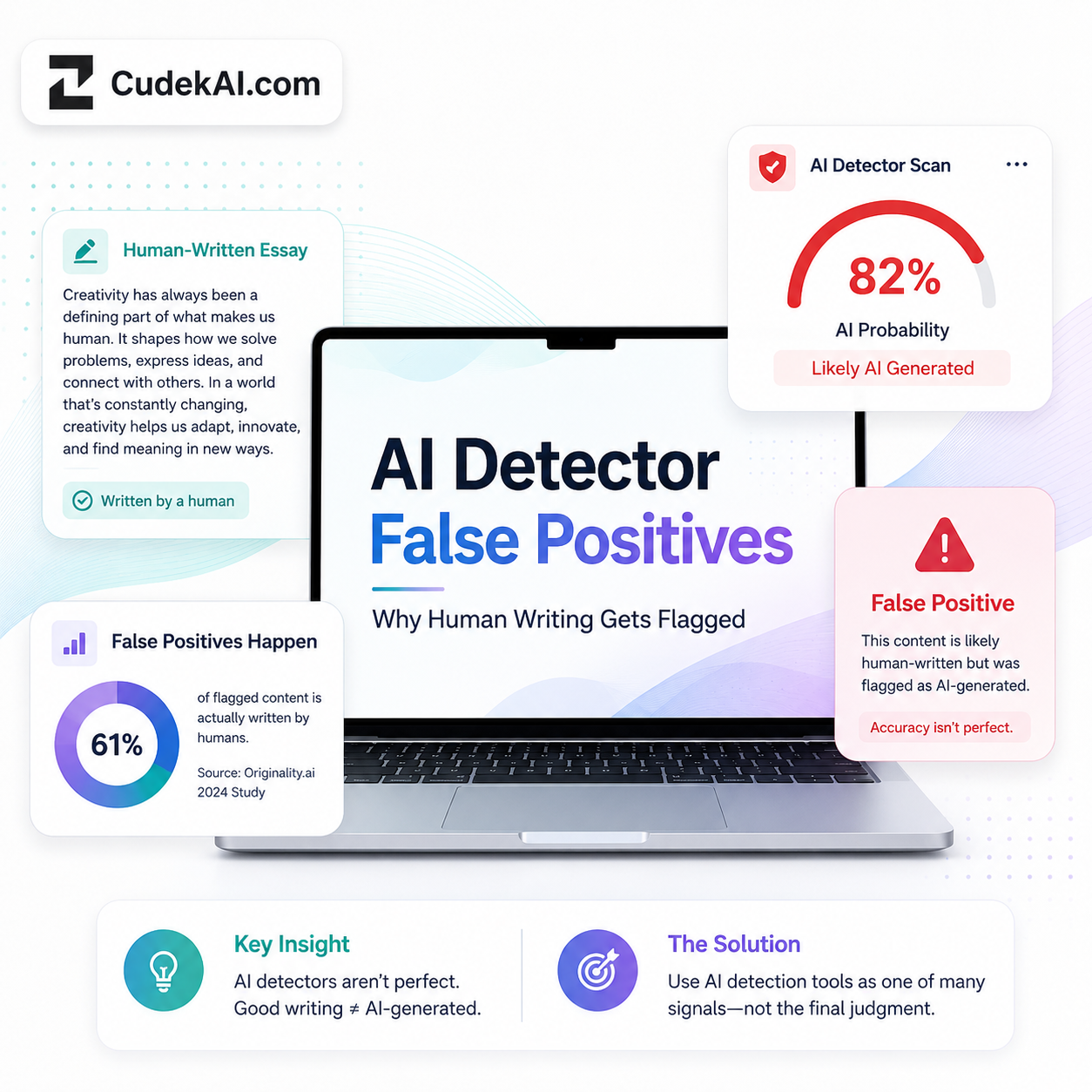
False positives occur when detectors incorrectly classify legitimate human writing as AI-generated content. ESL student writing, technical documentation, formal academic prose, and writers employing consistent professional styles may trigger false positives through patterns resembling AI uniformity.
Distinctive writing styles, specialized vocabulary, technical terminology, and formal academic conventions can exhibit characteristics that detectors associate with AI generation. Understanding false positive risks prevents inappropriate accusations based solely on detection scores, requiring contextual evidence and human judgment.
False Negative Risks
False negatives represent failures in identifying actual AI-generated content, incorrectly classifying it as human-written. Sophisticated editing, paraphrasing tools, AI humanizers, and manual revision reduce detection accuracy by 30-50% according to adversarial testing research.
Students employing humanization techniques, including varying sentence structures, removing mechanical transitions, injecting personal voice, and restructuring passages, evade detection by eliminating characteristic AI patterns. Multiple revision passes combining automated humanization with manual editing create mixed content, challenging classification.
Text Length Dependencies
Detection accuracy depends substantially on text length, where longer passages exceeding 1,500 words provide sufficient linguistic patterns enabling reliable statistical analysis. Short texts under 500 words produce unstable results where minor edits dramatically shift classification scores by 30-40%.
Brief passages lack the pattern density necessary for confident classification. Detection scores on short texts warrant extreme skepticism regardless of reported confidence levels. Longer writing samples exceeding 2,000 words provide a necessary statistical foundation for trustworthy detection.
When Should Detection Results Influence Decisions?
AI detection results require careful interpretation, considering confidence levels, text characteristics, and contextual evidence rather than automatic acceptance.
High Confidence AI Classifications
Detection results showing 95%+ AI confidence on substantial texts exceeding 2,000 words warrant serious consideration, indicating strong algorithmic certainty across multiple analytical dimensions. Pure AI content exhibiting numerous characteristic patterns, including low perplexity, minimal burstiness, narrow vocabulary, mechanical transitions, and structural consistency triggers reliable detection.
However, high confidence classifications should constitute primary evidence requiring corroboration through contextual analysis, writing sample comparison, and discussion with authors rather than a sole basis for academic penalties or professional consequences. Multiple platform verification strengthens confidence compared to single-tool reliance.
Moderate Confidence Requiring Judgment
Detection scores between 40% and 85% indicate mixed signals requiring careful human evaluation rather than automated judgment. Moderate classifications reflect legitimately mixed content, sophisticated editing, distinctive human styles, or fundamental detection uncertainty.
Ambiguous results demand expert review, examining specific flagged passages, comparing against the author’s previous work when available, and considering contextual evidence. Educators should engage students in discussing writing processes rather than issuing penalties based solely on moderate scores.
Skepticism on Short Texts
Detection results on texts under 1,000 words exhibit concerning volatility, warranting extreme skepticism. Short passages provide insufficient patterns for reliable analysis. Brief content detections should never constitute evidence for academic integrity violations or content authenticity judgments.
What’s the Future of AI Detection Technology?
AI detection technology continues evolving, addressing current limitations while adapting to advancing language model capabilities.
Advanced Detection Methods
Next-generation detection systems incorporate deeper semantic analysis, contextual understanding evaluation, knowledge consistency verification, and reasoning pattern assessment. These advanced methods analyze whether content demonstrates genuine understanding, logical coherence, factual accuracy, and domain expertise beyond surface linguistic patterns.
Watermarking technologies embed invisible signals within AI-generated text, enabling definitive identification. However, watermarks face implementation challenges, including voluntary adoption requirements, editing vulnerability, and translation susceptibility, limiting practical effectiveness.
Detection Arms Race
Continuous competition between AI generation and detection creates an ongoing adaptation cycle. As language models improve, generating more human-like text, detection systems require corresponding sophistication in analyzing subtler patterns. This arms race drives innovation in both generation and detection technologies.
Understanding this dynamic evolution prevents treating current detection capabilities as permanent or definitive. Detection reliability varies across AI platforms, content types, and editing sophistication, requiring nuanced interpretation accounting for technological limitations.
Final Thoughts
AI detectors work by analyzing writing patterns such as perplexity, burstiness, vocabulary distribution, sentence structure, and stylistic markers. These signals help distinguish machine-generated content from human writing. Detection systems rely on machine learning, natural language processing, and statistical pattern recognition to identify AI traits across multiple linguistic dimensions. CudekAI AI Detector uses a proprietary 15-dimensional analysis model trained on tens of millions of samples from major AI platforms. It provides sentence-level classification and clear confidence scores and delivers results in under 10 seconds, with trial access available for evaluation.
Effective AI detection also requires understanding its limitations, including false positives, false negatives, and reliance on text length. Results should not be treated as final proof but used alongside contextual evidence, writing comparisons, and author review. Organizations seeking reliable detection should prefer tools with multi-dimensional analysis rather than single-metric methods. CudekAI combines advanced detection architecture, extensive training, and transparent reporting, supporting academic integrity, content authenticity, and intellectual honesty.
Start the CudekAI trial, experiencing superior AI detection capabilities.