AI coding assistants now sit inside everyday development, which makes verifying who actually wrote a piece of code harder than ever. To check if code is written by AI, you can run it through an AI code detector, review it manually for telltale patterns, or trace its provenance through git history. This guide covers all three.
What Does AI-Generated Code Mean?
AI-generated code refers to source code that a large language model writes from a prompt instead of a human author typing it directly. Code assistants such as GitHub Copilot, ChatGPT, GPT-5, Claude, Gemini, Cursor, and Codeium can produce a snippet, a full function, or an entire project in seconds.
Most code today sits on a spectrum. Fully AI-written code is generated end to end by an AI tool. AI-assisted code is human-led work that uses AI autocomplete and inline suggestions along the way. Mixed code blends the two, with AI drafting parts and a developer editing the rest.
The label matters for detection. An AI code detector reads structural patterns most clearly in fully AI-written code, while heavy human editing blurs those patterns. Each category needs a slightly different approach to verify authorship.
Why Does It Matter to Detect AI-Generated Code?
AI-generated code raises different concerns depending on where it shows up. Educators worry about academic integrity, recruiters worry about real ability, and engineering teams worry about quality, security, and intellectual property. Detecting AI-written code lets each group make informed decisions instead of guessing about authorship.
How does it affect academic integrity?
AI-generated code threatens academic integrity in computer science courses, where students can submit AI-written solutions as their own. Educators use AI code detection to keep CS assignments fair and confirm students actually learned the material.
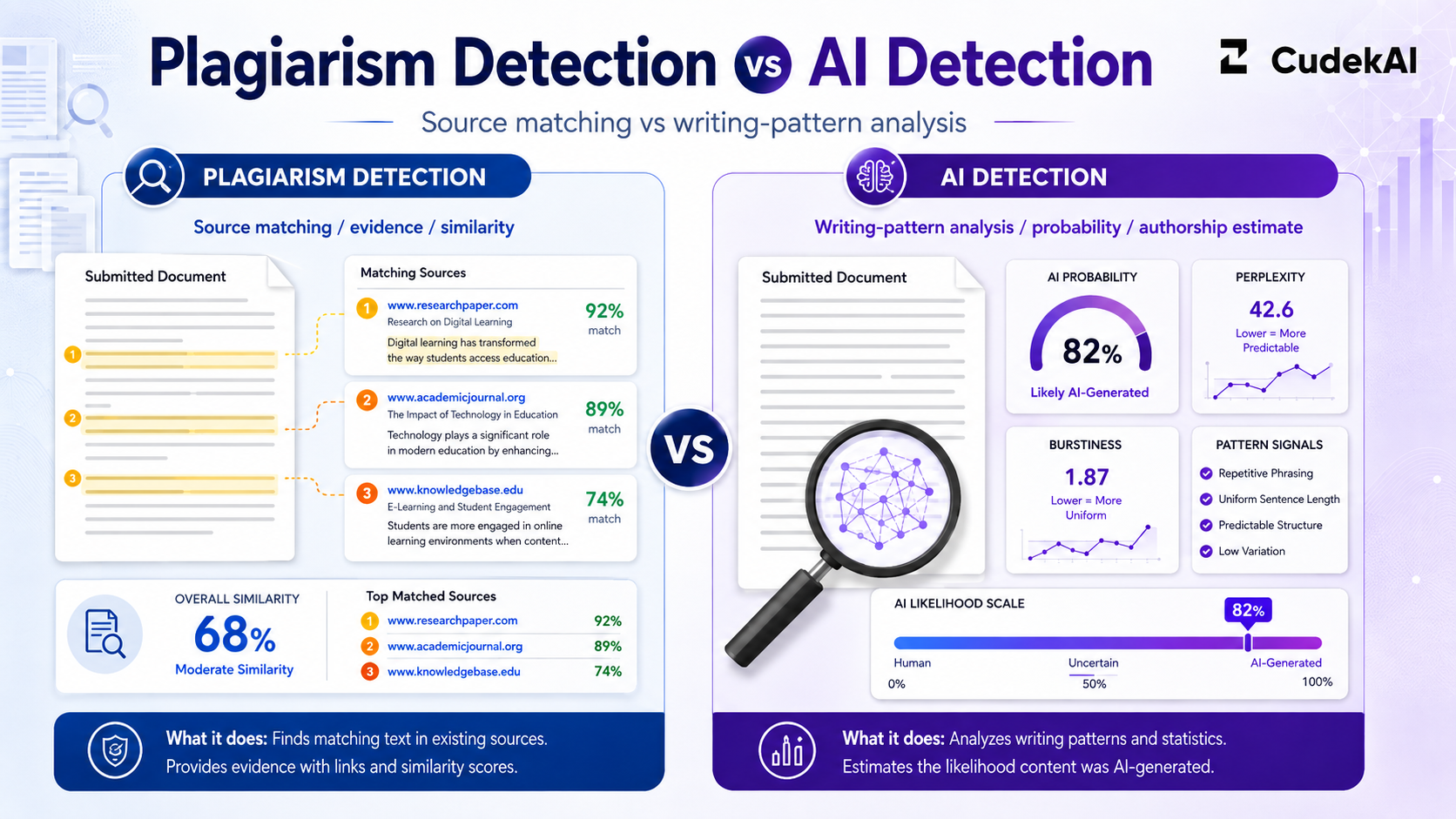
The problem is sharpest in competitive programming, where traditional plagiarism tools like MOSS catch fewer cases, because AI output rarely matches another student’s code directly. AI-generated submissions often look strikingly similar to one another instead, which detectors and instructors can flag as a secondary signal of AI use. Beyond code, educators can apply the same scrutiny to writing and assignments — see CudekAI’s guide on how teachers check for AI for the full picture.
Why do recruiters check for AI-written code?
Recruiters check for AI-written code because take-home tests and coding challenges are meant to measure a candidate’s real ability. AI-generated code lets an applicant pass a screening without the underlying skill, which surfaces later on the job.
Hiring teams use AI code detection to confirm that submitted solutions reflect genuine competence. Obfuscated or heavily reformatted code is itself a red flag, since candidates sometimes disguise AI output by renaming variables or stripping comments. Detecting AI-written code early keeps technical interviews fair and protects the quality of every hire.
How does it impact code review and security?
In engineering, AI-generated code affects code review, security, and ownership. AI tools often produce code that ignores a team’s best practices, coding standards, or naming conventions, so reviewers check authorship before merging it into the main codebase. AI-written code can also introduce hidden vulnerabilities or reference unsafe patterns, making security review essential.
Beyond quality, CTOs and legal teams detect AI-generated code to protect intellectual property and confirm codebase provenance, since AI output can raise licensing and ownership questions. Knowing what is AI-written keeps the codebase maintainable, secure, and legally clean.
What Are the Signs That Code Is AI-Generated?
AI-generated code shows recognizable signs across three areas: its comments and style, its logic, and its surrounding history. No single clue proves AI authorship, since clean human code can mimic some traits, but several signs together make AI-generated code likely.

Why do the comments and style stand out?
AI-generated code over-documents, attaching exhaustive line-by-line comments to even obvious statements, because AI models are trained to be helpful. The style looks unusually clean too: verbose, generic variable and function names, uniform formatting, and a tidy textbook structure that lacks the messiness and inconsistency real projects naturally accumulate over time.
What logic and functional quirks appear?
AI-generated code sometimes calls hallucinated or undefined methods, references APIs that do not exist, or wraps simple tasks in unnecessary helper functions that a developer would never add. These functional quirks are strong tells, especially in earlier or unedited output, where the code looks polished and complete yet fails to compile or run correctly.
What do context and edit history reveal?
AI-generated code often ignores project-specific context, skipping the conventions, dependencies, and naming a real codebase already uses. It also shows no incremental edit history, arriving as one finished block rather than evolving through commits. Across submissions, extreme internal similarity points to AI, since separate authors rarely produce near-identical patterns.
How Do AI Code Detectors Work?
AI code detectors work by analyzing patterns the human eye misses. Rather than reading the code’s meaning, they measure statistical and structural signals to estimate the probability that AI wrote it, from how predictable each token is to how the underlying logic is built.
How do detectors use probability and perplexity?
AI code detectors estimate token probability — how likely each token is in context. AI-generated code is highly predictable, so it produces low perplexity. Training-free methods go further: they mask lines, regenerate them with a surrogate model, and compare the results to flag AI authorship.
What patterns do machine-learning detectors analyze?
Machine-learning detectors read code-level statistics that humans overlook, such as AST depth, identifier length, and line count. Deep-learning stylometric classifiers, like GPTSniffer-type models, train on thousands of human and AI samples to recognize each model’s coding style and classify new code as human-written or AI-generated.
Why do structural fingerprints matter?
Structural fingerprints capture how code is built — its control flow, error-handling style, and function composition. They matter because they survive surface edits: renaming variables, reformatting, or adding comments changes how code looks, not how it is structured. AI code detection still works after a cleanup.
How Do You Check if Code Is AI-Generated with CudekAI?
CudekAI AI Code Detector checks whether code is AI-generated in three steps. Add your code, run the scan, and review a clear report with no setup or sign-up required.
Paste or upload your code
Paste your code, drag and drop a file, or upload a full repo or codebase. CudekAI AI Code Detector reads all programming languages, including Python, JavaScript, TypeScript, Java, C++, PHP, Go, and SQL.
Run the AI code scan
Run the scan and CudekAI delivers results in under 10 seconds, even for large code blocks. It detects the language automatically and analyzes code without depending on any watermark or metadata.
Review the detection report
Review a structured report that classifies code as AI, mixed, or human and gives an AI likelihood score. A heatmap and segment-level highlighting show which lines triggered the flag, with authorship and IP verification included.
How Can You Detect AI-Generated Code Manually?
Manual code review detects AI-generated code by checking process, not just appearance. Start with git history: run git blame and study the commit timeline, since AI-written code often lands in one large commit with no incremental version history. Next, ask the author to explain the code line by line, because someone who didn’t write it usually can’t. In classrooms and hiring, compare cross-submission similarity with tools like MOSS flag near-identical answers as a secondary signal of AI use. Combine these checks, and manual review confirms what a detector suggests.
What Are the Limitations of Detecting AI-Generated Code?
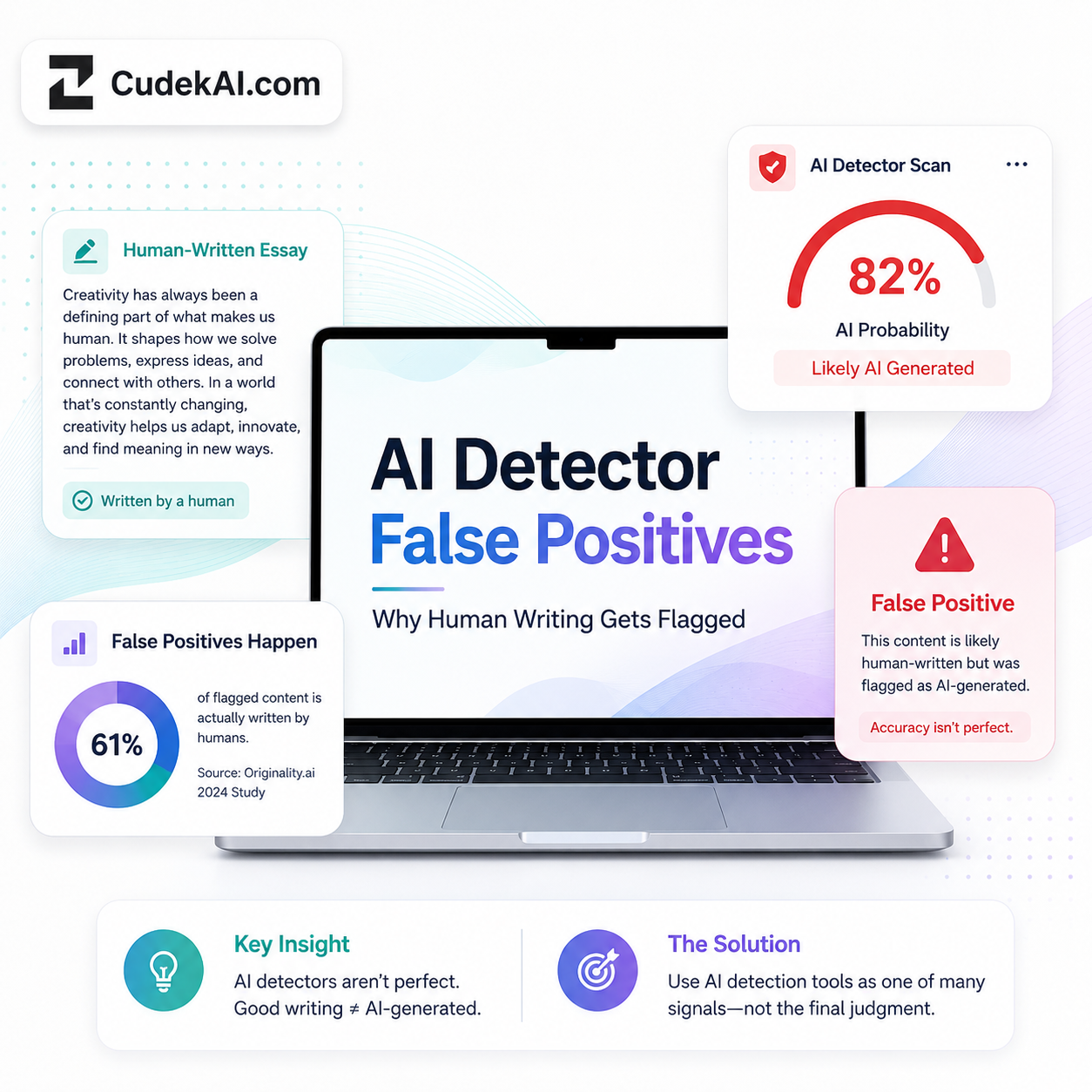
AI code detection has real limits. Short snippets under 10 lines and uncommon languages lower accuracy, and boilerplate or config files carry little statistical signal. Code also has fewer degrees of freedom than prose, especially in C or Assembly, so humans and AI can write identical optimal solutions. That causes false positives on clean senior-developer code and strict style guides. Humanizers rename variables without restructuring logic, often introducing bugs in the process.
Frequently Asked Questions
Can you tell if code is AI-generated?
Yes, you can tell if code is AI-generated, though rarely with certainty. An AI code detector like CudekAI estimates the probability, while manual review and git history add supporting evidence, they give a reliable read rather than a guaranteed verdict.
How do teachers detect AI-generated code?
Teachers detect AI-generated code by running submissions through an AI code detector and reviewing them manually for tells like over-documentation and uniform structure. They also compare cross-submission similarity with tools like MOSS, since AI answers often look near-identical across a class.
Can AI-generated code be detected after it’s edited or humanized?
Often, yes. Renaming variables, reformatting, or adding comments changes how code looks, not its structural fingerprints like control flow and function composition, so detectors still flag it. Humanizers also tend to introduce bugs, which is a signal in itself.
Which programming languages can CudekAI AI Code Detector check?
CudekAI AI Code Detector checks all languages, including Python, JavaScript, TypeScript, Java, C++, PHP, Ruby, Go, Swift, HTML, CSS, and SQL. It detects the language automatically when you paste or upload your code.
Is AI code detection 100% accurate?
No, AI code detection is not 100% accurate. Detectors return a probability score, not a binary verdict, and accuracy drops on short snippets, boilerplate, and uncommon languages — so treat the result as a strong signal to verify, not final proof.
Can code from GitHub Copilot, ChatGPT, or Claude be detected?
Yes. CudekAI AI Code Detector identifies code from GitHub Copilot, ChatGPT, Claude, and other LLM-based assistants, because each model leaves distinctive structural patterns the detector recognizes.
Is CudekAI AI Code Detector free?
Yes. CudekAI AI Code Detector is free to use for initial & limited use you can paste or upload code and get an AI-vs-human result without sign-up or payment.
Conclusion
You can check if code is AI-generated three ways: scan it with an AI code detector, review it manually for tells like over-documentation, and trace its provenance through git history. No method is perfect — detectors return a probability, not a verdict, and accuracy drops on short or edited code — so the strongest approach combines all three. Run your code through CudekAI AI Code Detector for a fast, clear AI-vs-human result in seconds.