AI Humanizer
Turn AI-generated texts into human-like writing. Refined content reduces detection while maintaining clarity.
Supported Languages:
English
French
Spanish
German
All others
1 Credit Cost
Detection Mode
Basic
Advance
Optional Add-ons
Sentence Analysis
Detailed Sentence level detection
Plagiarism Checker
Scan copied text online
AI Image Detector
Check if an image is AI-generated
AI Detector detects AI written content with paragraph-level detection, sentence-level detection, and word-level analysis. It evaluates AI vocabulary, commonly used AI words, and overused words.
The AI Detector applies document-level detection to scan mixed documents, both AI- and human-generated. CudekAI AI Checker verifies AI-generated patterns with accurate results.
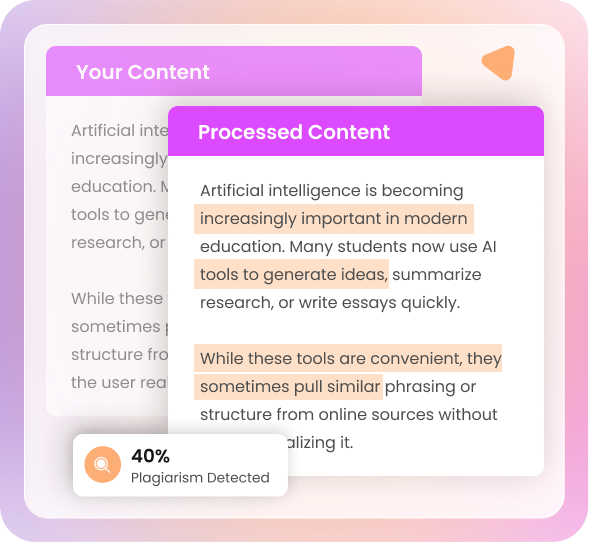
AI Checker detects copied content, accidental plagiarism, and duplicate content. CudekAI plagiarism detector scans essays, articles, research papers, and web content to verify content originality.
CudekAI combines AI detection and plagiarism scanning for a complete originality analysis.
AI Plagiarism CheckerCudekAI Image Detector scans AI-generated visuals. It verifies AI image authenticity across multiple supported formats. The AI Image Checker reviews visual content to score the AI probability.
The image detector classifies results using an AI rate and a visual AI score to indicate low, medium, or high AI possibilities with clear and structured image analysis for accurate verification.
AI Image Detector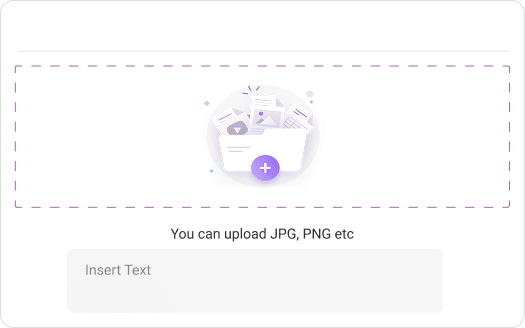

CudekAI Video Detector scans videos for AI-generated and deepfake content. It analyzes frames across the timeline to verify whether footage is authentic or synthetically produced.
The video detector returns a clear AI probability with frame-level signals, helping you spot manipulated or fully AI-generated clips with structured, reliable analysis.
AI Video Detectordetector.py
CudekAI Code Detector analyzes source code to identify AI-generated patterns across Python, JavaScript, TypeScript, Java, C++, Go, and more. It examines naming conventions, comment style, and structural signals to verify code authorship.
The AI code checker delivers an AI vs. human likelihood score with line-level highlighting and a clear verdict to support code reviews, hiring assessments, and academic integrity checks.
Use AI Code DetectorAI Resume Detector scans resumes, cover letters, and CVs for AI-generated writing patterns. It analyzes sentence structure, phrasing, and sentence variety to identify AI-written passages.
CudekAI returns an AI probability score with per-sentence predictions and classifies the document as AI-generated, human-generated, or mixed.
AI Resume Detector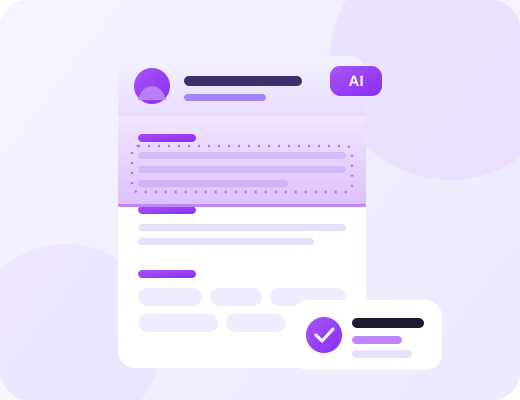
Turn AI-generated texts into human-like writing. Refined content reduces detection while maintaining clarity.
Detects copied content and identifies accidental plagiarism through advanced detection algorithms.
Identify and fix grammar, punctuation, and sentence structuring. Improve readability in one click.
Review tone, structure, and readability score to detect overlooked mistakes before submission.
Detect AI writing across English, Spanish, French, German, Japanese, Hungarian, and more.
Translate content across 104 languages while keeping original intent and context.
Check essays for AI patterns, plagiarism, and structuring. Assists in fair grading.
Convert long documents into concise summaries. Focused summarization keeps info direct.
Rewrite sentences to improve clarity and avoid repetition without losing key intent.
Reword sentences and paragraphs using synonyms to enhance readability and flow.
Paste text directly to start the checking process. Enter a URL or upload DOCX, PDF, TXT, or RTF files. CudekAI AI detector scans up to 15000 characters.
Run the AI checker to perform word-level, sentence-level, paragraph-level, and document-level analysis. The AI detector automatically scans for AI-generated and plagiarized content.
The CudekAI detector will scan the text in seconds. Download the detailed report in PDF and DOCX format or create a shareable link.
Detect AI content generated by the top AI models
Detects Content Generated By GPT-5, GPT-4, GPT-3, GPT-4.1, And GPT-4.1-Mini. Accurate AI Probability Scoring Ensures Reliable Analysis.
CudeKAI AI Checker Detects Text By Gemini 3, Gemini 2.5 Pro, Gemini 2.5 Flash, And Gemini 2.5 Flash-Lite With Structured Analysis.
Identify Robotic Text From Claude Sonnet 4 Using Sentence-Level And Document-Level Analysis.
The AI Detector Identifies Linguistic Patterns Produced By Llama.
Detects Text Generated By DeepSeek Models With Adaptive AI Fingerprint Analysis
Analyze AI-Written Content Created By Grok With Cross-Model Comparison Logic..
Accuracy, Detailed Analysis, Instant Results
CudekAI uses a highly accuracy model for reliable AI detection. Independent benchmarking and large-scale testing verify its detection accuracy. The AI detector model minimizes false positives and misclassifications, while benchmarks confirm consistent performance across multiple AI models.
CudekAI is trusted by teachers, students, and researchers across academic institutions, colleges, and universities. The school system uses an AI detector to check AI in essays, papers, and blog content for accurate verification.
Copywriters, marketers, recruiters, publishers, and authors rely on its precise AI detection score. Every submission is analyzed to ensure high-stakes content meets originality standards.
Best for agencies
Custom Pricing
Credits: Tailored for You
AI Detector
Humanizer
Plagiarism Checker
AI Image Detector
All Apps Included
Translator
Performs bulk AI detection with API integration by inputting content and getting API access to the AI detector for automated checks. The API supports AI detection, plagiarism checking, paraphrasing, and translation.
Instant
Bulk Analysis
Ready to automate?
Get API access today.
Free Ai content detector tool is available in 103 language
English
Afrikaans
Albanian
Amharic
Arabic
Armenian
Azerbaijani
Basque
Belarusian
Bengali
Bosnian
Bulgarian
Catalan
Cebuano
Chichewa
Chinese Simplified
Chinese Traditional
Corsican
Croatian
Czech
Danish
Dutch
Esperanto
Estonian
Filipino
Finnish
French
Frisian
Galician
Georgian
German
Greek
Gujarati
Haitian Creole
Hausa
Hawaiian
Hebrew
Hindi
Hmong
Hungarian
Icelandic
Igbo
Indonesian
Irish
Italian
Japanese
Javanese
Kannada
Kazakh
Khmer
Korean
Kurdish
Kyrgyz
Lao
Latin
Latvian
Lithuanian
Luxembourgish
Macedonian
Malagasy
Malay
Malayalam
Maltese
Maori
Marathi
Mongolian
Myanmar
Nepali
Norwegian
Pashto
Persian
Polish
Portuguese
Romanian
Russian
Samoan
Scots Gaelic
Serbian
Sesotho
Shona
Sindhi
Sinhala
Slovak
Slovenian
Somali
Spanish
Sundanese
Swahili
Swedish
Tajik
Tamil
Telugu
Thai
Turkish
Ukrainian
Urdu
Uzbek
Vietnamese
Welsh
Xhosa
Yiddish
Yoruba
Zulu
Cudekai's AI detector has been a real stress reliever. Some of my professors are strict about AI-written work, and this tool gives me confidence that my papers look authentic before I turn them in.
Daniel

I use Cudekai's humanizer tool after finishing my papers to make sure they actually sound like me. It smooths out the writing and makes everything flow naturally—like my own voice, just better polished.
Chelsea
Whenever I'm stuck trying to rephrase something, I just drop it into Cudekai's rewriter. It gives me cleaner, clearer versions in seconds and saves me so much time for other work.
Ricardo
Cudekai's plagiarism checker is really solid. The reports are detailed but easy to understand, which makes fixing issues much quicker. It's a must-have for my projects.
Michael